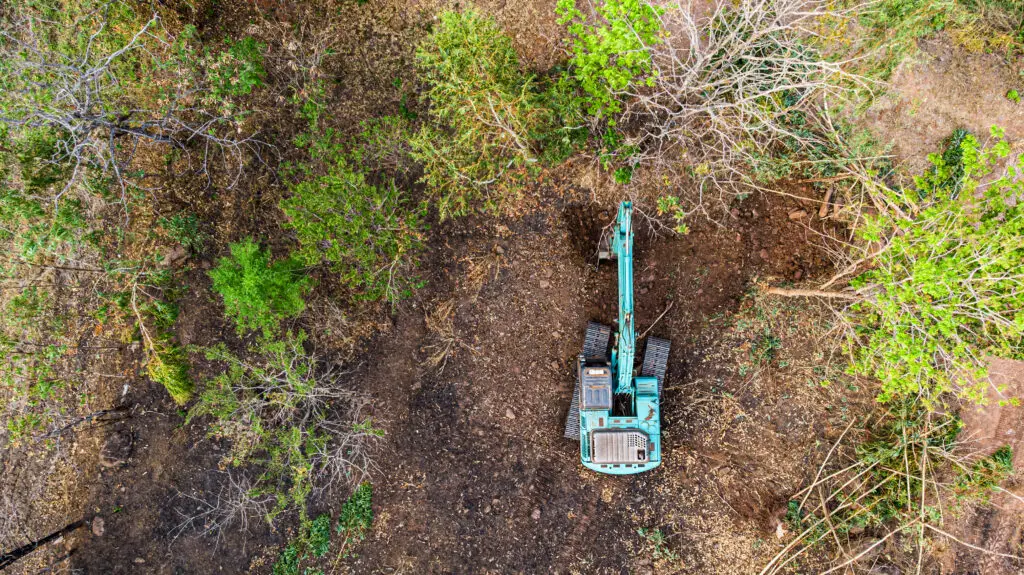
Forestry mulching is a single-machine land clearing method that grinds brush, saplings, and woody vegetation into mulch on the spot — no hauling, no burning, no debris piles left behind. For most property owners in upstate New York dealing with overgrown fields, encroached pastures, or wooded lots they want to reclaim, it’s the most efficient and least disruptive way to get the job done. This guide covers everything you need to know: how the process works, what equipment is involved, what it actually costs in this region, and how to know when it’s the right call for your land.
What Is Forestry Mulching?
Forestry mulching is a land clearing process where a single piece of equipment — typically a skid steer or tracked carrier fitted with a mulching head — drives through overgrown vegetation and processes everything it contacts into wood chip mulch. The mulch stays on the ground. No trucks haul it away. No burn piles smolder for days.
The mulching head itself uses rotating blades or flail-style teeth to shred brush, saplings, and small trees at high speed. Depending on the head style, the material gets cut, ground, and spread in a single pass. What was chest-high brush an hour ago becomes a clean, chip-covered clearing by afternoon.
This is different from brush hogging, which mows vegetation down but leaves cut stems and stalks. And it’s different from traditional land clearing, which often involves a bulldozer pushing everything into piles that then need to be hauled away, burned, or buried. Forestry mulching processes the vegetation right where it stands, which eliminates the debris management step entirely.
> Did You Know: The mulch layer left after forestry mulching typically suppresses weed regrowth for one to two growing seasons and adds organic matter back to the soil as it breaks down — a benefit you don’t get with bulldozing or burning.
The Equipment: What Gets Used and Why It Matters
Most forestry mulching operations in the northeast use one of two machine types: a skid steer with a mulching head attachment, or a dedicated tracked mulching machine. The equipment choice isn’t just a brand preference — it directly affects what jobs can be done safely and what the finished result looks like.
Skid Steer with Mulching Attachment
A skid steer fitted with a mulching head is the most common setup for residential and smaller commercial jobs. It’s maneuverable, can work close to structures and property lines, and handles brush, saplings, and trees up to about six to eight inches in diameter effectively. At Upstate NY Brush Control, we run a skid steer with a forestry mulching attachment — it’s the right tool for most of the jobs we see, which tend to be overgrown residential lots, pastures reclaiming from brush, and wooded parcels being prepped for a structure or driveway.
Tracked Carriers vs. Wheeled Machines
Here’s something that matters for property owners in this region specifically: upstate New York ground is not flat, dry Texas pasture. We deal with glacial till — a mix of clay, sand, and rock deposited when the last ice sheet retreated. That soil holds water. Spring conditions in Saratoga, Albany, and Schenectady counties mean you can have standing water in a field well into May, and the ground stays soft in spots even after it looks dry on the surface.
Tracked machines spread their weight across a much larger footprint than wheeled skid steers. On the rocky, wet, or uneven terrain common here, a tracked machine stays stable and does far less damage to the ground. Wheeled machines on soft soil leave deep ruts and can get stuck in low spots. Anyone quoting a job on a wet upstate NY property with a wheeled machine should give you pause — the right equipment for this terrain is tracked.
Drum Mulchers vs. Disc Mulchers
The mulching head itself comes in two primary styles. Drum mulchers use a rotating cylinder with carbide teeth. They produce finer mulch and can grind stumps flush with the ground, which is preferred when you want a clean finish. Disc mulchers use blades on a rotating disc — they work faster but leave coarser material and stumps at ground level. For most residential and agricultural clearing jobs, a drum mulcher delivers the cleaner result. For large-acreage jobs where speed matters more than finish quality, disc can make economic sense.
> Pro Tip: Ask any contractor what mulching head style they’re running before you hire them. For a property you plan to seed or mow after clearing, a drum mulcher that grinds stumps flush with the ground is the right call. A disc mulcher that leaves two-inch stubs will become a mowing problem.
What Does Forestry Mulching Cost Per Acre?
This is the question every landowner asks, and the honest answer is that national pricing guides are almost useless for planning a budget in upstate New York. Here’s why: those averages pull data from flat, dry pasture in Oklahoma and Texas, where a machine can clear two to four acres a day through light brush. This region is different.
Upstate New York properties tend to have denser, harder-to-process vegetation — decades of multiflora rose, buckthorn, honeysuckle, and thick woody growth that has layered into near-impenetrable stands. Add rocky terrain, wet spring ground, and the short accessible season, and production rates are slower than the national average. That reality shows up in the pricing.
Typical Price Ranges for Upstate NY
Here’s a practical breakdown of what landowners in this region should expect:
| Property Condition | Estimated Cost Per Acre |
| Light brush, thin saplings, accessible flat ground | $1,000 – $1,500 |
| Moderate growth, mixed brush and 3–6″ saplings, some slope | $1,500 – $2,000 |
| Dense overgrowth, thick woody brush, invasive species, rocky terrain | $2,000 – $2,800+ |
| Heavy vegetation with 6–8″+ trees, difficult access, steep terrain | $2,800 – $3,500+ |
These ranges reflect the northeast market premium that upstate NY properties consistently command over national averages. The wide spread between light and heavy clearing is real — an acre of light brush can be cleared in two to three hours, while an acre of mature multiflora rose thicket can take a full day. That’s a 3x or 4x difference in machine time on the same acreage.
What Drives the Price Up
Several factors push cost higher on any given job:
Vegetation density. This is the single biggest variable. The difference between “overgrown” and “hasn’t been touched in 20 years” is meaningful to an equipment operator. Dense, layered growth with established root systems takes more passes and more time.
Tree diameter. Most skid steer mulching heads handle trees up to six to eight inches in diameter efficiently. Trees larger than that slow the machine significantly, and very large trees often need to be felled separately before the mulcher can process the remaining material.
Terrain and access. Rocky, hilly ground slows equipment down. Properties with steep grades, limited entry points, or no clear access lane for the trailer add setup time and difficulty.
Mobilization. Moving a tracked skid steer to your property costs time and money. For smaller jobs — half an acre or less — mobilization is a meaningful share of the total cost. Many contractors charge a minimum job fee for this reason. For larger multi-acre jobs, the per-acre rate tends to come down because the mobilization cost spreads across more acreage.
Season and ground conditions. Jobs done in winter on frozen ground are often more efficient — the machine has better traction, vegetation is dormant (which makes processing faster), and access is easier on hardened soil. Jobs in mud season can be difficult or impossible to schedule without risking equipment getting stuck or causing significant ground damage.
> Did You Know: Forestry mulching is typically 20–40% less expensive than traditional land clearing when you factor in the full picture — because you eliminate the cost of hauling debris, renting additional equipment for pile management, and any burning permits or fees. The comparison is rarely apples-to-apples, but on moderate-density properties, mulching almost always wins on total cost.
5 Benefits of Forestry Mulching Property Owners Often Overlook
The efficiency of a single machine doing the whole job is the selling point most people hear first. But there are five real benefits that matter more once you’re thinking about what the land looks like a year or two after the work is done.
1. Soil Protection
Traditional land clearing with a bulldozer strips and compacts topsoil. Years of erosion follow, especially on any sloped ground. Forestry mulching leaves the topsoil intact and adds a wood chip layer that reduces surface runoff. Research published in Soil & Tillage Research found that organic mulch cover reduced soil loss by up to 76% compared to bare soil — a meaningful number for any property owner on hilly upstate NY terrain near a stream or drainage area.
2. No Burn Pile, No Permit Headache
Burning land clearing debris requires a DEC permit in New York State, and the state’s annual spring burn ban — which runs March 16 through May 14 each year — prohibits all residential brush burning entirely during that window. Towns and villages can also layer stricter ordinances on top of state rules. Forestry mulching eliminates the debris entirely — there’s nothing to burn. For property owners who’ve dealt with the paperwork, a neighbor’s complaint, or a fire that got a little too ambitious, not having a pile is its own reward.
3. One-Pass Efficiency
Traditional clearing involves multiple pieces of equipment, multiple mobilizations, and multiple stages: cutting, pushing, piling, burning or hauling. Forestry mulching compresses all of that into one machine doing one pass. For most residential-scale jobs, that means a single crew, a single day, and a single invoice. Less coordination, less downtime, faster access to your cleared land.
4. Invasive Species Management
This matters specifically for upstate New York properties, where multiflora rose, autumn olive, buckthorn, and Japanese knotweed have established themselves aggressively. A forestry mulcher processes these invasives at ground level and interrupts their growth cycle. It’s not a permanent fix for the most aggressive species — follow-up management matters — but mulching is one of the most effective mechanical methods for significantly reducing invasive brush density in a single operation.
5. Native Regrowth Conditions
Because forestry mulching doesn’t strip and compact the soil, the seed bank in the ground stays intact. Native grasses, wildflowers, and desirable woody species have a better chance of coming back naturally in the years following mulching. If you’re reclaiming a pasture and want it to return to productive grass ground, starting from mulched soil rather than bulldozed bare earth gives you a much better foundation.
> Pro Tip: If your goal is to reclaim a field for grazing or hay production, consider overseeding with a desirable grass mix within a few weeks of mulching. The disturbed mulch layer creates good seed-to-soil contact, and you’ll get ahead of the weed pressure that comes in once the brush is gone.
Forestry Mulching vs. Other Land Clearing Methods
Understanding where forestry mulching fits compared to other options helps you make the right call for your specific situation.
Forestry Mulching vs. Traditional Land Clearing (Dozing)
Dozing is the right choice when you need a completely bare site — construction grading, large-scale excavation, or a project where the soil itself is going to be moved and shaped. Dozing removes everything and leaves a blank slate. The tradeoff is significant ground disturbance, the need to manage debris, and the erosion exposure that comes with bare soil.
Forestry mulching is the better choice when you want to clear vegetation without disrupting the ground beneath it, when you have irregular terrain or areas near water, or when you want to leave some trees standing and clear around them selectively. You can’t really do selective clearing with a bulldozer.
Forestry Mulching vs. Brush Hogging
Brush hogging is designed for open fields and meadows with low-growing vegetation — grass, soft brush, and light annual growth. It’s fast, cost-effective, and well-suited for maintenance mowing of already-cleared areas. But a brush hog has limits. It can’t handle trees larger than a few inches in diameter, leaves cut stems at an inch or two above the ground, and does nothing for dense, established woody brush. If your field has grown in with multiflora rose, sumac, or young trees, a brush hog won’t touch it. That’s a forestry mulching job.
Think of brush hogging as maintenance and forestry mulching as reclamation. One keeps clear land clear. The other takes land that has grown over and starts it back from scratch.
Forestry Mulching vs. Manual Clearing
Hand clearing — chainsaw crews and brush cutters working on foot — makes sense for small areas, selective work around structures, or situations where equipment access is impossible. It’s slow, expensive per acre, and physically demanding. For any job larger than a quarter acre of dense brush, mechanized mulching is faster and more cost-effective. The quality of finish is also higher, because a mulching head processes everything flush with the ground rather than leaving cut stems and scattered debris.
| Method | Best For | Limitations |
| Forestry Mulching | Overgrown brush, reclamation, selective clearing, wet/rocky terrain | Not for total bare-site prep or very large timber |
| Traditional Dozing | Construction site prep, total site clearing, grading | High disturbance, debris management required |
| Brush Hogging | Field maintenance, light annual growth, flat open land | Can’t handle dense brush or established trees |
| Manual Clearing | Small areas, no equipment access, tight selective work | Slow, expensive per acre, limited scale |
What to Expect: The Forestry Mulching Process from Estimate to Finished Property
Understanding how a job actually unfolds helps you know what to prepare and what questions to ask.
The Estimate Visit
A professional forestry mulching contractor should come to your property before giving you a price. Photo estimates based on satellite images or Google Maps are a starting point at best. The density of the vegetation, the condition of the ground, the access situation, and any obstacles (old wire, buried fence posts, debris) all affect the job meaningfully. A site visit catches the variables a satellite image misses.
During the estimate, you’ll walk the property and identify what stays and what goes. Any trees you want preserved should be marked before the crew shows up — flagging tape or paint both work. Point out known obstacles like buried fence lines, old fence posts, or any underground utilities you’re aware of.
Day of the Job
The machine gets unloaded, the operator walks the perimeter, and work begins. On a residential lot or small acreage job, you’ll be surprised how quickly the machine moves through brush. A property that looked like a jungle on Monday morning can be a clear, chip-covered field by afternoon.
> Did You Know: Before a forestry mulching crew starts, tell them about any old wire or buried fence posts in the area to be cleared. Old barbed wire is a real hazard — it can tangle in the mulching head, causing damage and downtime. A good crew will check for it, but your local knowledge of the property matters.
One important note for upstate New York jobs specifically: if your property has wet low spots, it’s worth flagging those for the operator. Depending on ground conditions and machine weight, low spots may need to be avoided or approached carefully to prevent getting equipment stuck. Spring and early summer scheduling around known wet areas saves headaches.
After the Job
When the crew packs up, your property will look dramatically different. The ground will be covered with a layer of wood chip mulch — thickness depends on how dense the vegetation was, but a few inches is typical. There won’t be debris piles, stumps left at height, or bare scraped earth.
The mulch layer will start breaking down within the first growing season. Most landowners see native grasses and forbs coming back within a few months. If you want to accelerate the process — for grazing, food plots, or a lawn area — you can overseed immediately. The disturbed mulch surface is actually good seedbed contact.
> Pro Tip: After mulching, plan to revisit the property in year two. Some brush species, especially multiflora rose and sumac, will resprout from root systems that survived. A single follow-up mowing or spot mulching pass at the two-year mark keeps the regrowth from getting ahead of you and is far less work than the original clearing.
For fence line clearing, there’s also the buried wire question: our fence line and fence row clearing service includes pre-work to identify and clear old wire before the mulching head gets near it — something that matters on farms where fence lines have been buried in brush for years.
When Forestry Mulching Makes Sense for Your Property
Not every parcel is a forestry mulching job. Here’s a practical guide to the situations where it’s clearly the right call, and the ones where another method fits better.
Forestry mulching is the right call when:
- Your property has grown in with brush, saplings, and woody vegetation over multiple years
- You want to clear land without creating a debris management problem
- The terrain is rocky, hilly, or has wet areas that would make traditional dozing difficult
- You want to preserve some trees and clear selectively around them
- You’re near a water body, stream, or wetland and need to minimize ground disturbance
- You’re reclaiming a pasture, opening a field, or prepping land for a structure or driveway
- You need fence line clearing in areas with old buried wire or established woody growth
Forestry mulching is not the right call when:
- You need completely bare soil for a construction project that requires grading
- The trees on your property are large-diameter timber that a skid steer head can’t process
- Your entire project is light annual mowing of an already-open field (brush hogging costs less)
- Access to the property is too tight or soft for any tracked equipment
When you’re genuinely unsure, the estimated visit answers the question. A qualified operator can walk your land and tell you which method makes the most sense — and a good one will tell you honestly if another approach is a better fit for what you’re trying to accomplish.
Preparing Your Property Before the Crew Arrives
You don’t need to do much before a forestry mulching crew arrives, but a few steps make the job go smoother:
Mark what stays. Any tree or shrub you want preserved should be flagged clearly. Bright flagging tape tied at eye level works well. Point it out to the operator before work starts — don’t assume they’ll know.
Know your property lines. If your lines aren’t clearly marked, the operator can’t reliably stop at the right place. Survey stakes or visible line markers help. At minimum, walk the boundaries with the operator before the machine starts.
Identify buried obstacles. Old barbed wire, buried fence posts, concrete debris, and scrap metal are all common on older agricultural properties in upstate New York. Let the operator know what you’re aware of. For properties with known buried wire, a walk-over with a metal detector or a pre-clearing sweep by a hand crew makes sense before the mulching head gets near it.
Arrange equipment access. A skid steer on a trailer needs a clear, firm path from the road to your clearing area. If you need a temporary gate opening or brush cut for trailer access, take care of that before the scheduled day to avoid downtime.
Check for active wildlife. If you’re clearing in spring or early summer, be aware that ground-nesting birds may be active. A quick walk-over of the area a few days before can identify active nests. Many experienced operators will naturally avoid disturbing obvious nests if flagged, but this is your call as the landowner.
Once those basics are handled, the crew handles the rest. For a professional land clearing assessment of your specific property, a site visit is the best starting point.
Upstate NY Terrain: What Makes This Region Different
This deserves its own section because the land here really is different from what most national guides describe — and those differences affect how forestry mulching jobs are planned, priced, and executed.
David McKenzie, who owns and operates Upstate NY Brush Control, grew up on a working dairy farm in Galway. He’s been running equipment on this terrain since he was a teenager. His observation, shared plainly: “The ground here holds water in a way that flat land in other parts of the country doesn’t. We have low spots that look dry from the road but are still saturated three feet down in May. And the rocks — glacial till means you never know exactly what’s under the brush until you’re in it.”
That’s not a complaint about the terrain — it’s the reality that shapes how experienced operators approach work in this region. Scheduled jobs get assessed for ground conditions before the machine goes in. Spring jobs get honest conversations about timing. Properties with visible low spots or standing water get flagged during the estimate, not discovered on day one.
That kind of upfront communication is what separates a professional land clearing contractor from someone who just owns a machine. The equipment is the same. The judgment about when, where, and how to use it is what matters.
Frequently Asked Questions About Forestry Mulching
What is forestry mulching?
Forestry mulching is a single-machine land clearing method where a skid steer or tracked carrier fitted with a mulching head grinds brush, saplings, and small trees into wood chip mulch that stays on the ground. It clears land in one pass without hauling debris, burning, or creating debris piles. It’s one of the most efficient and least disruptive ways to reclaim overgrown property.
How much does forestry mulching cost per acre in upstate New York?
For most properties in the Saratoga, Albany, and Schenectady area, expect to pay $1,000 to $2,800 per acre depending on vegetation density, terrain, and accessibility. Light brush on flat, accessible ground runs lower; dense, multilayered overgrowth on rocky or wet terrain runs higher. The best way to get an accurate number is an on-site estimate — national averages pulled from flat, dry land in other regions are rarely applicable here.
How long does forestry mulching take?
A typical skid steer mulching operation clears one to three acres per day depending on vegetation density. A half-acre residential lot with moderate growth usually takes four to six hours. A multi-acre pasture reclamation with dense woody brush can take two to three days. Your contractor should give you a realistic timeline during the estimated visit.
Does the mulch need to be removed after the job?
No. The mulch layer stays on the ground and breaks down naturally over one to two growing seasons, adding organic matter back to the soil. You don’t haul it away, rake it, or manage it. If you’re seeding after clearing, the mulch surface is actually good for seed contact and moisture retention.
Can forestry mulching be done near water or in a wetland buffer?
Yes, and it’s often preferred near water because it causes far less ground disturbance than dozing or excavation. The mulch layer controls erosion and sediment runoff rather than exposing bare soil. That said, any work within New York State’s designated wetland buffers or regulated areas requires a check with the NYS DEC for permit requirements before work begins. A qualified contractor will raise this during the estimate if it’s relevant to your site.
Is forestry mulching better than burning or using herbicides to clear brush?
For most property owners, yes. Burning land clearing debris requires a DEC permit in New York, the annual spring burn ban runs March 16 through May 14, and burning doesn’t eliminate the root systems of invasive species. Herbicide treatment is effective for follow-up maintenance but slow as a primary clearing method for dense brush. Mechanical forestry mulching addresses dense brush efficiently in a single operation without either of those tradeoffs.
Ready to Reclaim Your Property?
Forestry mulching is one of the most practical and efficient tools available for upstate New York landowners dealing with overgrown brush, encroached fields, or wooded lots they want to put back into use. The process works. The results hold up. And the land it leaves behind — stable, chip-covered, and ready for what comes next — is in better shape than what a bulldozer would leave.
If you have land that needs clearing in the Saratoga Springs, Albany, Schenectady, Glens Falls, or surrounding area, Upstate NY Brush Control offers free on-site estimates. Call or text David at (518) 631-3191, or contact us through our website to schedule a time to walk your property. No cost, no pressure — just an honest look at what you’re working with and what it would take to get it cleared.